
Gardening Made Simple.
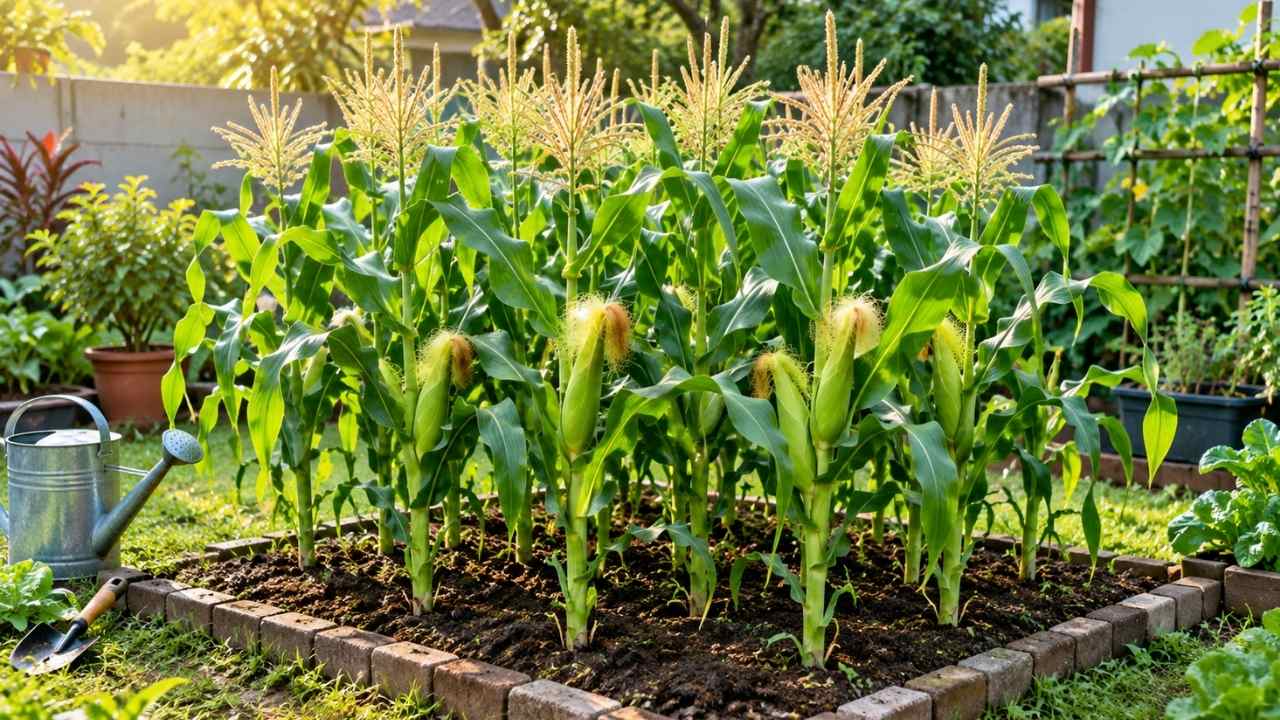
Learning how to grow sweet corn in small spaces is a little like arranging seats around a table: the plants need enough room to develop, yet they must stay close enough to work together. The key is pollination. Because sweet corn relies mainly on wind, a compact block usually produces fuller ears than one long row.
For a productive small plot, use a block or square layout of about 4 feet × 4 feet. Space seeds or seedlings roughly 6 to 8 inches apart, feed the soil well, provide 6 to 8 hours of direct sunlight, and keep the ground evenly moist. When air movement is limited, gentle hand pollination can therefore improve results.
How to grow sweet corn in small spaces depends more on plant arrangement than on the total size of the garden. A compact square or block helps wind-borne pollen move from the tassels at the top of the plants to the silks forming below. As a result, this improves the chance of kernels developing across each ear.
Choose a growing area close to 4 feet × 4 feet whenever possible. A slightly different shape can work, but avoid placing every plant in one narrow line. Although sweet corn planted in a long row may have plenty of soil space, pollen can miss many silks when wind moves along the row instead of across it.
Before sowing, mark the area. Then divide the space into small planting points with about 6 to 8 inches between plants. This spacing is close enough to support pollination while leaving room for roots, leaves, and routine watering.
Small-space growing works best when the plot is treated as one pollination group. For that reason, avoid scattering a few plants in separate containers or distant corners. Even if each plant grows well, isolated plants may receive less pollen and produce ears with missing kernels.
Each sweet corn plant produces pollen from its tassel and receives pollen through its silk. Since wind carries the pollen, nearby plants create a stronger pollination network than widely separated plants. That is why a square block can outperform a single row in a compact garden.
Plant height also matters. A block allows tassels to overlap within the same general air space. As breezes pass through the leaves, pollen has more opportunities to land on nearby silks. The result is not guaranteed; however, the layout gives the crop a better starting point.
Consider a small raised bed, patio border, or open section beside a vegetable plot. The bed does not need to be perfectly square. Instead, what matters is keeping the plants grouped rather than stretched into a thin line.
For a small sweet corn patch, place seeds or seedlings about 6 to 8 inches apart. This closer spacing supports cross-pollination, but the soil must remain fertile and adequately watered because plants will compete more strongly for nutrients and moisture.
Measure the distance from the centre of one planting point to the next. In addition, consistent spacing makes it easier to water the full root area and inspect the plants for weak growth. Crowding beyond the suggested range can reduce air circulation and increase competition, especially in heavy soil.
Planting too far apart creates a different problem. Wind may carry pollen away before it reaches nearby silks. Therefore, in a small garden, the aim is not simply to fit in the greatest number of plants. The aim is to create a close, healthy group with enough resources for each plant.
| Layout choice | Pollination value | Best use | Main caution |
|---|---|---|---|
| 4 feet × 4 feet block | Strong grouping for wind pollination | Small beds and open garden plots | Needs fertile soil and regular moisture |
| Long single row | Less reliable in a small plot | Larger gardens with many plants | Pollen may not reach every silk |
| 6 to 8 inch spacing | Close contact between plants | Compact sweet corn planting | Avoid excessive crowding |
| Hill planting | Dense local pollen group | Very limited growing areas | Thin weak seedlings after emergence |
A useful planning method is to draw the bed on paper before planting. For example, a 4 feet × 4 feet block can be divided into repeated points with 6 to 8 inch gaps. This simple sketch prevents accidental row planting and shows whether the available space can support a practical number of plants.
Hill planting can help when space is extremely limited because several seeds grow close together in one small group. Sow 4 to 5 seeds in each circular planting hole, then allow the strongest plants to remain as they develop. Consequently, the clustered stems can create a concentrated source of pollen.
Make shallow, evenly spaced holes rather than deep pits. Then place each hill within the wider block so the groups still function as one pollination area. A few hills scattered across a 4 feet × 4 feet space are more useful than several isolated hills around a large garden.
When seedlings emerge, check their colour and strength. If every seedling remains, the group may become too crowded. The supplied method allows 4 to 5 seeds per hole, but thinning can be sensible if plants are visibly weak or soil moisture becomes difficult to maintain.
Hill planting is not a replacement for good soil. Dense groups need steady access to nutrients and water. In sandy soil, moisture may disappear quickly, whereas in compact clay, roots may struggle even when the surface looks wet. Adjust watering and soil preparation to the conditions of the site.
Hill planting may be unsuitable where drainage is poor or where the bed cannot be watered evenly. Closely grouped plants can suffer together if water collects around their roots. Likewise, a shaded corner can limit the entire group because sweet corn needs 6 to 8 hours of direct sunlight each day.
Use individual spacing instead when you need very clear access between plants for weeding, watering, or inspection. A block with 6 to 8 inch spacing offers a useful middle ground. It preserves pollination benefits without forcing every plant into one dense hole.
Sweet corn is a heavy-feeding crop, so fertile soil is central to successful small-space growing. Before planting, mix in well-rotted compost or other suitable organic matter. A nitrogen-containing fertiliser may also be needed, but the amount should follow the product label and the results of a local soil test.
Work compost into the planting area rather than placing a large amount directly against each seed. This spreads nutrients through the root zone and reduces the risk of concentrated fertiliser damaging young roots. Additionally, soil should remain loose enough for roots to expand and water to drain.
Small beds can lose fertility quickly because several plants share a limited volume of soil. Watch for pale leaves, slow growth, or thin stems. These signs can have several causes, including poor drainage or insufficient light, so do not add nitrogen automatically without checking the growing conditions.
A long-term approach is more reliable than a heavy single application. Improve the bed before planting, keep organic matter replenished, and avoid planting sweet corn repeatedly in the same depleted patch without restoring nutrients. For general soil guidance, consult the Royal Horticultural Society’s soil and compost guidance.
Compost improves soil structure and adds organic matter, while nitrogen supports leafy growth. However, neither option should be treated as a complete substitute for the other in every garden. The best choice depends on existing fertility, soil texture, previous crops, and the fertiliser’s instructions.
Sweet corn generally needs at least 6 to 8 hours of direct sunlight each day. Water the soil consistently and aim for about 1 inch of water per week, adjusting for rainfall, heat, wind, and soil type. In particular, even moisture matters most during active growth and ear development.
Check the soil near the root zone instead of relying only on the surface. The top layer may look dry while deeper soil still holds moisture. Conversely, heavy soil can remain wet below the surface after light rain. A simple finger check can help reveal the condition, although very wet soil should also be allowed to drain.
Water slowly around the base of the plants so moisture reaches the roots. A light sprinkle that wets only the leaves may evaporate quickly and leave the root zone dry. Meanwhile, mulch can help reduce evaporation, but keep it slightly away from the stems to improve airflow.
In a compact bed, neighbouring plants can use water quickly. That makes a weekly estimate of 1 inch a useful planning guide rather than a rigid rule. During hot or windy periods, the bed may need more frequent checks. During rainy periods, additional watering may be unnecessary.
Hand pollination is optional, but it can help when natural airflow is weak. In the morning, gently shake the upper tassels so pollen falls across nearby silks. You can also transfer pollen by hand from the tassels toward the silks without bending or damaging the plants.
Pollination becomes especially important when plants are grown beside a wall, fence, greenhouse, or sheltered balcony. These locations may receive enough sunlight but very little moving air. Even so, a small block improves the chances of pollination, while gentle assistance can support the process.
Handle the plants carefully. Shaking should be light rather than forceful, and hand transfer should not tear the silk. Repeat the process when pollen is available and the silks are visible. The exact timing can vary because tassels and silks may not appear together on every plant.
Hand pollination cannot correct every problem. Poor light, weak plants, dry soil, or severe nutrient stress can still reduce ear quality. Therefore, it should be viewed as a practical backup for sheltered growing, not as a substitute for suitable spacing and healthy plants.
The most common mistake is planting sweet corn in one long row because it appears tidy. In a small garden, that arrangement can weaken wind pollination. A second error is placing a few plants in separate containers, where each group may receive too little pollen to fill the ears properly.
Overcrowding is another concern. The suggested 6 to 8 inch spacing is already compact, so adding many extra plants may create competition for light, water, and nutrients. Plants that look tall but remain thin may be struggling rather than thriving.
One overlooked issue is uneven watering across the block. Plants at the edge may dry faster than those in the centre. Therefore, place the water source so the full planting area receives moisture, then check several points rather than testing only one spot.
The most dependable plan combines a compact block, 6 to 8 inch spacing, fertile soil, steady moisture, and strong sunlight. Hill planting can replace individual points when space is very tight, while gentle hand pollination can support plants in sheltered locations.
Use this checklist before sowing:
For example, a gardener with a small square bed can place plants throughout the area instead of creating a single line along the edge. In this way, the arrangement uses the same limited ground more intelligently because every plant contributes to a shared pollination zone.
The best choice for a balcony or tiny courtyard may be a compact block of containers grouped closely together. However, containers dry faster than garden soil and may provide less root volume. As a result, they require more frequent checks, even when the general target remains about 1 inch of water each week.
Yes. Sweet corn can grow in a small garden when plants are grouped in a block, spaced about 6 to 8 inches apart, and given fertile soil, sunlight, and regular moisture.
A block keeps more tassels and silks within the same air space. Since wind carries corn pollen, this arrangement improves the chance that pollen reaches nearby silks.
Planting 4 to 5 seeds in one hill can suit a very small space. However, thin weak seedlings if the group becomes crowded or struggles for water and nutrients.
Sweet corn needs at least 6 to 8 hours of direct sunlight each day for strong growth. Consequently, a shaded site can reduce plant strength and ear development.
Aim for about 1 inch of water per week, then adjust for rainfall, heat, wind, soil type, and container conditions. Before watering again, check the root zone.
Hand pollination is optional. It can help when the crop grows in a sheltered place with little airflow. Gently shake tassels in the morning or move pollen toward the silks.
Not always. Hill planting suits limited space, but poor drainage or severe crowding can weaken the group. Therefore, use regular spacing when the soil stays wet or access is difficult.
Small-space sweet corn growing succeeds when the planting design supports pollination from the beginning. A 4 feet × 4 feet block, 6 to 8 inch spacing, fertile soil, 6 to 8 hours of sun, and about 1 inch of weekly water create a practical foundation.
Choose hill planting only when it fits the soil and watering conditions. In sheltered sites, gentle morning hand pollination can provide extra support. Before planting, measure the space, improve the soil, and confirm that every part of the block can receive sunlight and moisture.
Information check and update: Spacing, watering needs, fertiliser guidance, and local growing advice can vary with soil, climate, and container conditions. Verify product instructions and regional recommendations before planting. Last verified: October 2026.
Subscribe to the blog and newsletter to get new updates in simple, clear words straight to your inbox.
Recent Articles
Related Articles
Keengarden is your simple, friendly guide to growing healthy plants, fixing garden problems, and choosing the right tools.
© 2025 keengarden. All rights reserved. Designed by Affpilot