
Gardening Made Simple.
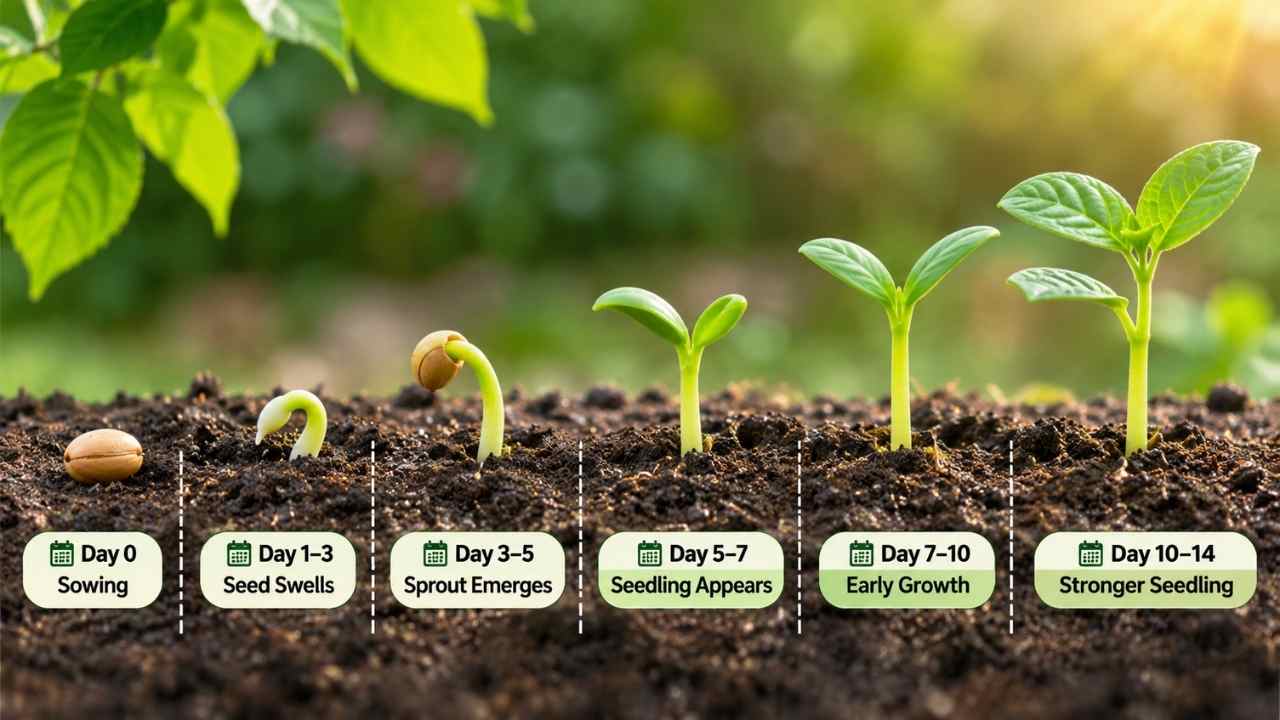
How long for seedlings to sprout? Most seeds emerge within 3 days to 3 weeks, or roughly 7 to 21 days, when temperature and moisture suit the plant. For example, radishes and lettuce can appear in just a few days, while peppers and parsley may need several weeks.
However, the exact timing depends on seed type, soil warmth, moisture balance and sowing depth. Therefore, a seed packet remains the best reference because it usually lists the expected “days to germination” for that specific variety.
For reliable results, keep the growing medium consistently moist without making it waterlogged. Most seeds perform best when the soil stays near 70°F to 75°F, or 21°C to 24°C.
Quick answer:
How long for seedlings to sprout depends mainly on the plant variety and growing conditions. In many cases, common garden seeds emerge in 3 days to 3 weeks. A warm medium near 70°F to 75°F supports steady germination, whereas cold soil can slow the process sharply or stop emergence altogether.
Moisture matters just as much. The medium should feel like a wrung-out sponge rather than a soaked container. If the surface dries out during the first few days, the seed may not complete the early stages of germination. On the other hand, saturated soil can reduce air around the seed.
Seed packets often provide a useful range such as “7 to 14 days.” Still, treat that range as a guide rather than a fixed deadline. A cool windowsill, unusual seed depth or older seed can shift the result.
Fast sprouters generally emerge within 1 to 7 days when warmth and moisture are suitable. Radish, lettuce, spinach, beets, kale and turnips commonly belong in this group. As a result, their short waiting period makes them useful choices when you want an early visual sign that your seed-starting conditions are working.
Even fast seeds may take longer in cool soil. For example, a tray placed near a cold window may remain inactive while the same tray in a warmer location begins emerging sooner. Therefore, avoid digging up the seeds after only a few days because that can disturb fragile roots.
| Plant group | Typical germination time | Examples |
|---|---|---|
| Fast sprouters | 1 to 7 days | Radish, lettuce, spinach, beets, kale and turnips |
| Moderate sprouters | 7 to 14 days | Tomatoes, corn, beans, squash, cucumbers and carrots |
| Slow sprouters | 2 to 4+ weeks | Peppers, eggplant, parsley, parsnips and rosemary |
Moderate sprouters usually need 7 to 14 days. Tomatoes, corn, beans, squash, cucumbers and carrots are common examples. Meanwhile, slow sprouters can require 2 to 4 weeks or longer. Peppers, eggplant, parsley, parsnips and rosemary often fall into this slower category.
These groups help with planning. If you sow lettuce beside peppers on the same day, the lettuce may appear well before the pepper seedlings. However, that difference does not automatically mean the pepper seeds are defective. It may simply reflect the plant’s normal germination pattern.
Long-term planning becomes easier when you record the sowing date on each tray. For instance, marking “carrots, day 1” or “peppers, day 1” prevents premature resowing. It also helps you compare the actual emergence time with the range printed on the packet.
Temperature, moisture and light depth are the three practical conditions that most directly affect early germination. Most seeds prefer a warm soil temperature between 70°F and 75°F, equal to 21°C to 24°C. Consequently, cooler soil can slow growth drastically or prevent the seed from sprouting.
Moisture should remain consistent from sowing until emergence. Water gently when the surface begins to dry, but do not leave the container waterlogged. In addition, a heavy stream can move small seeds too deeply or expose them at the surface.
Sowing depth needs equal care. Many seeds prefer darkness or indirect light until they break through the surface. Tiny seeds are different because they often need surface light exposure. Therefore, the seed packet should take priority when its instructions differ from general guidance.
Efficient seed starting is less about checking the tray every hour and more about creating stable conditions for the full germination window. Place containers where the temperature remains reasonably consistent. Otherwise, a location that becomes cold overnight can extend the waiting period even if daytime conditions seem suitable.
For example, if a tomato packet says 7 to 14 days, checking the tray on day 5 may create unnecessary concern. Instead, maintain moisture and warmth through day 14. If nothing appears after the listed range, reassess temperature, depth and moisture before sowing again.
One useful efficiency habit is grouping seeds by expected timing. Fast crops can share a monitoring schedule, while slow crops receive a longer window. As a result, this approach reduces unnecessary disturbance and makes future planting decisions more predictable.
The most common mistake is treating every seed as if it follows the same timetable. A radish and a pepper planted on the same day should not be judged by the same deadline. Instead, plant-specific timing provides a more accurate basis for deciding whether a tray needs attention.
Seed age and storage history can also influence results. Therefore, when the packet gives specific instructions for temperature or light, follow those instructions rather than relying only on a general gardening rule.
Check the seed packet before sowing and again if seedlings have not appeared by the expected time. The packet may list an exact “days to germination” range along with the preferred depth, light conditions and temperature. Those details are more useful than applying one timetable to every crop.
For a reliable comparison, write down three details: the sowing date, the growing location and the first emergence date. This simple record shows whether a delay is linked to a particular tray or to a broader change in temperature. In turn, it supports better planning for the next planting cycle.
For additional general growing information, the Royal Horticultural Society seed propagation guidance offers a reliable reference. Gardeners in the United States can also compare packet instructions with advice from their local university extension service.
Yes. Radish, lettuce, spinach, beets, kale and turnips can emerge within 1 to 7 days when the medium is warm and consistently moist.
Not necessarily. Many seeds sprout within 7 to 21 days, while peppers, parsley and similar slow seeds may need 2 to 4 weeks or longer.
Most seeds prefer soil between 70°F and 75°F, which equals 21°C to 24°C. Cooler soil can slow germination or prevent emergence.
The medium should stay consistently moist like a wrung-out sponge. It should not become waterlogged because excess water can create poor conditions around the seed.
Many seeds prefer darkness or indirect light before emergence. Very small seeds may need light at the surface, so check the packet for specific instructions.
Wait through the full germination range printed on the packet. Then review temperature, moisture and sowing depth before deciding whether to resow.
Knowing how long for seedlings to sprout helps you plan trays without rushing the process. Use 7 to 21 days as a broad guide for many seeds, then adjust expectations for fast, moderate or slow plant types.
Keep the medium evenly moist, maintain a suitable temperature and follow the packet’s light and depth directions. If the expected period passes without emergence, check the conditions methodically rather than disturbing the seeds immediately.
Information that can change includes seed-packet recommendations, variety-specific germination ranges and local growing guidance.
Subscribe to the blog and newsletter to get new updates in simple, clear words straight to your inbox.
Recent Articles
Related Articles
Keengarden is your simple, friendly guide to growing healthy plants, fixing garden problems, and choosing the right tools.
© 2025 keengarden. All rights reserved. Designed by Affpilot